
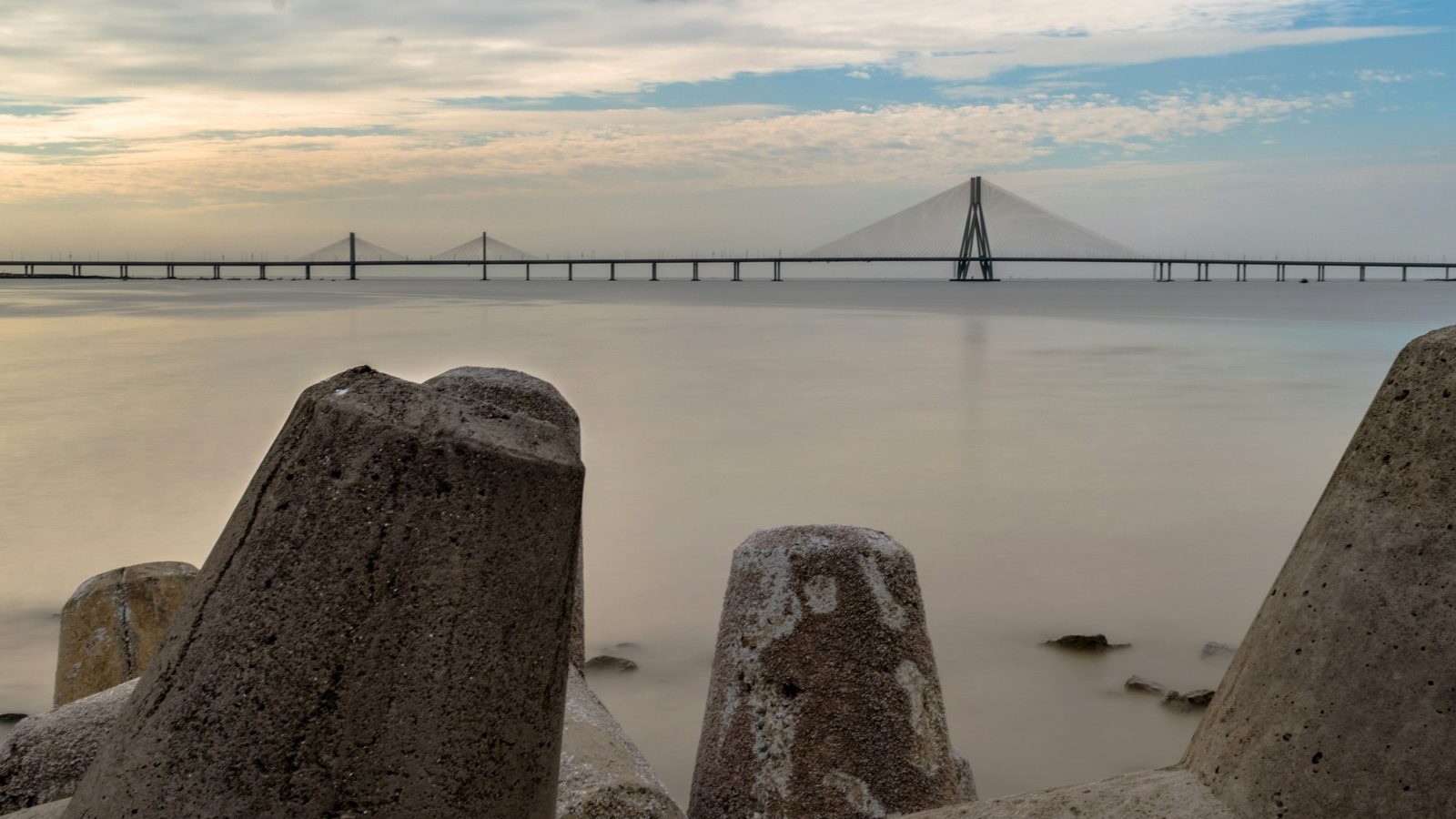
In May the sun goes down over the Arabian Sea at about ten past seven, and the Worli sea face fills up as it does. By October the sun sets an hour earlier, and the same people are still there at seven, walking in the dark under the lamp posts with the Sea Link lit up at the far end. The hour has stayed fixed for decades. The light around it changes with the season, and in the last few years it has changed with the Coastal Road as well.
This piece follows that hour at street level. It is the companion to the next Neighbourhood Guide, on living in Worli, in the way our Matunga breakfast walk sits beside the Matunga guide: that one will be the address, this one is the evening that a family buying into it is really paying for.
Six thirty, Worli Dairy end
The walk starts at the southern end, where Khan Abdul Ghaffar Khan Road leaves the Worli Dairy junction and runs north along the water. The first people out are the serious ones: walkers in running shoes who do the length and back twice, and retired couples who do it once, at a pace that has not changed in twenty years.
The Worli sea face is about two kilometres from end to end. Regulars measure it in lamp posts and benches, not kilometres. They know which stretch has the wind in June, and which bench the same three men have occupied since before the Sea Link was built.
The sea wall is the point of it. It is a low concrete edge with tetrapods below, and people sit on it facing the water with their backs to the traffic. A man selling roasted corn from a handcart works the monsoon months here. In the dry season the wall belongs to couples, who stay well apart from one another along it.
The light, before and after the Coastal Road
For most of the last decade the walk was a building site. The Coastal Road works took the old promenade apart, and for several years regulars walked around barricades or went elsewhere. The rebuilt walk came back in 2025 with new paving, new lamp posts and a barrier between pedestrians and the traffic.
The Coastal Road's own promenade, which most people now call the Worli promenade, opened on 15 August 2025, a separate 5.25 kilometre stretch running south from Worli towards Haji Ali and Priyadarshini Park. Four pedestrian underpasses connect it to the city, two of them in Worli, near Worli Dairy and at Bindumadhav Thackeray Chowk. It is wider and newer than the sea face. Some stretches of it are darker after sunset than walkers would like, and the old regulars still mostly prefer the Worli sea face they know to the new Worli promenade.
What changed most is sound. The sea face used to be the one place in Worli where the water was louder than the road. A steady line of cars now runs closer to the sea, and the surf has competition. Buyers asking about the Coastal Road property impact at new projects in Worli usually mean travel time, and that impact is real: Nariman Point is now about twenty minutes away by car in normal traffic. The cost of that gain is a quieter kind of noise on the walk itself, and nobody puts it in a brochure. That half of the Coastal Road property impact is harder to price, and it falls hardest on the buildings that face the water.
Seven o'clock, the dog circuit
By seven the walk changes hands. The runners thin out and the dogs arrive, most of them with the people paid to walk them. Labradors and golden retrievers dominate, and a handful of indie dogs adopted off Worli's own streets keep pace with them.
The dog walkers are the best-informed people on the Worli sea face. They walk it twice a day, every day of the year, and they know which buildings have changed hands, which tower's construction has stopped and started again, and which society has signed with a developer. A buyer looking at flats in Worli for sale could learn more in a week of evenings beside them than from a month of site visits.
There is a quiet rule about pace. The walk moves north on the sea side and south on the building side, roughly, and anyone who stops dead in the middle to take a photograph of the Sea Link finds out.
The Worli sea face sells itself as a view, but the people who live beside it are paying for an hour, and the hour is the part a buyer cannot see on a site visit.
The Sea Link end
The northern end narrows towards Worli Koliwada, the fishing village that was here centuries before any of the towers. Worli Fort, built by the British in the 1670s to watch the creek, stands above the village on a small rise. At dusk the boats come in below it, and the smell of the day's catch drying meets the smell of the sea.
From here the Bandra-Worli Sea Link fills the view, its cable-stayed towers lit after dark. This is the image people mean when they ask for Worli Sea Link view flats, and brochures for new projects in Worli lead with it. It is also an image that depends on which way a window faces and what stands between it and the water. A flat that sees the Sea Link today sees it until somebody builds on the plot in front, and in Worli somebody usually does. Worli Sea Link view flats are priced on a promise that the city does not have to keep.
The Koliwada is also a reminder of who was here first. Its fishing families fought the Coastal Road's design for years, and won a wider gap between the bridge pillars so their boats could pass. Their village is not a backdrop to the walk. It is a working neighbourhood with its own pace, and it sets the tone for the evening at this end.
Things to do in Worli after the walk
The walk ends where the evening starts. Dr Annie Besant Road runs parallel to the sea face a few streets inland, and most of the things to do in Worli after dark sit along it or just off it.
The Nehru Centre and its planetarium hold the cultural end of things to do in Worli, with talks, exhibitions and shows that draw families on weekends. The NSCI Dome brings concerts and sporting events, and on those nights the streets around it slow to a standstill. Further south, towards Lower Parel, the old mill compounds now hold offices and restaurants that keep going after the walkers have gone home.
Anyone moving here should know that autorickshaws do not run in the island city, so the trip to dinner is a taxi, a car or a walk. The guides to living in Worli Mumbai portals publish rarely mention it, or the fact that parking is harder to find after eight than a table.
Worli vs Prabhadevi, at walking pace
Many buyers who come for the sea face end up comparing Worli vs Prabhadevi, its neighbour to the north and east. Prabhadevi has Siddhivinayak, the station and a denser, older street life. It does not have the Worli sea face, and the evening there is a different thing: shops, temple crowds and traffic rather than the wall and the water.
The Worli vs Prabhadevi price gap reflects that. A buyer comparing flats in Worli for sale against Prabhadevi is paying, in large part, for the walk. Listing portals put average asking rates at roughly ₹71,000 to ₹74,000 per square foot in Worli in 2026, and around ₹66,650 in Prabhadevi. A buyer who would walk the sea face every evening should probably pay the difference. A buyer who would walk it twice a year probably should not.
The same logic applies to the wider search. Portals often group new flats in Dadar Parel Worli together, and the rates across those three span a range wide enough to be meaningless. Walk the evening in each before comparing new flats in Dadar Parel Worli on price.
Walking it before buying
Anyone shortlisting new projects in Worli should walk the Worli sea face at seven on a weekday and again at seven on a Saturday. The weekday shows the regulars. The weekend shows the crowds that come from the rest of the city, and how the streets behind the sea face cope with their cars.
Before visiting flats in Worli for sale, stand at the foot of the building and listen for the Coastal Road. Then go up to the floor you would buy on and listen again. Most new projects in Worli are towers of forty floors and more, and the noise changes with height. Check whether the view promised in the brochure looks across an empty plot, because an empty plot in Worli is a future tower.
Then come back in the monsoon. The Worli sea face in July, with spray coming over the wall and the corn seller's cart steaming, is the version residents talk about. The next guide in this series looks at the address behind the walk, and at what living in Worli asks of the people who choose it.
Gala Habitats is building in Worli. Aakasa Worli stands off Dr Annie Besant Road, where it meets the Prabhadevi link, about five minutes by car from both the Sea Link and the Coastal Road. It is a tower of 3, 4 and 5 BHK flats, registered with MahaRERA under P51900050463, so the traffic, the construction next door and the evening crowds described above are part of what its buyers will live with too.