
Matunga starts eating before most of Mumbai has woken up. The first kitchen on this walk opens at five, and by nine the tables that were full an hour earlier are being wiped down for a thinner mid-morning crowd. For anyone weighing residential projects in Matunga, those four hours describe the neighbourhood more accurately than any floor plan does.
This is one weekday morning on foot, a Matunga food guide organised by the clock rather than the menu, from the first shutter to the nine o'clock clear-out. The places are real and named. None of them is reviewed, because the point is not what to order. The point is the rhythm, and for anyone considering living in Matunga Mumbai offers few better previews than this walk.
Before six, on Bhandarkar Road
Ram Ashraya on Bhandarkar Road opens at five and has been feeding Matunga since 1939. The first customers are not visitors. They are walkers on their way back from King's Circle and people coming from an early visit to one of the temples nearby, and a few office shirts with a long train ride ahead of them.
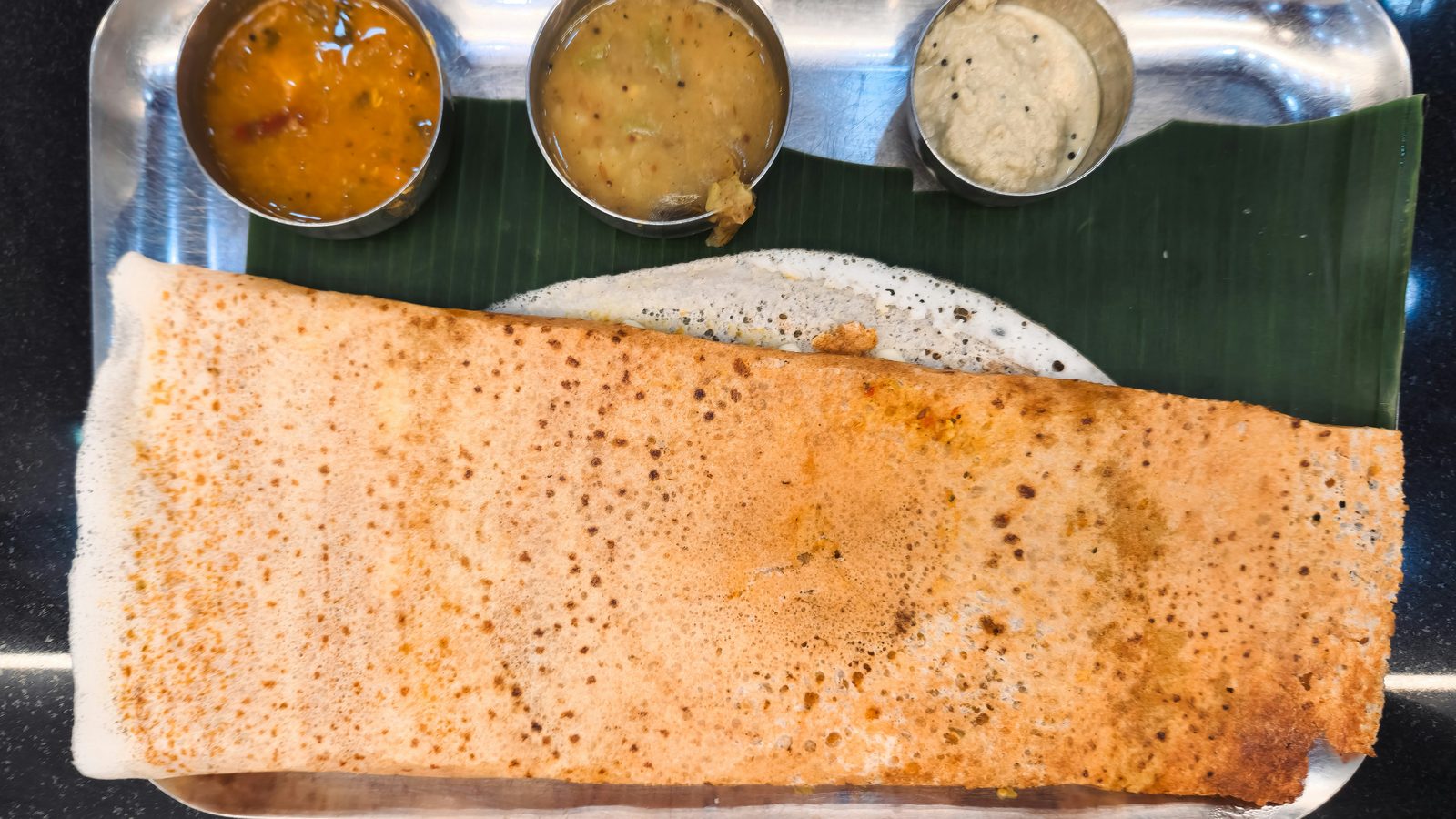
The room runs on steel tumblers of filter coffee and very little conversation. There is a Matunga South Indian breakfast order that regulars place without looking at anything, and the kitchen is often halfway through it before they sit down.
Outside, the street is still dark and almost empty of cars. It is the only hour of the day that is true.
A few minutes away, Maheshwari Udyan is already filling with walkers doing slow laps of the garden at King's Circle, and for the next hour the pavement around it is the busiest in Matunga. On letterheads and delivery apps the address is usually written as King Circle Matunga, and many of these walkers will be back at a café table under that address before seven.
Seven o'clock at King's Circle
At seven the shutters go up around Maheshwari Udyan, the garden at the centre of King's Circle, and the Matunga South Indian breakfast moves indoors. Café Madras, on the edge of the circle, opens at seven, and so does Café Mysore across from the garden, which has been serving in Matunga since the 1930s. They are the two names that come up first whenever anyone lists the best breakfast places in Matunga, and within fifteen minutes both have people waiting outside.
The waiting is the thing to notice. Nobody seems to mind it. Grandparents who have been coming for decades stand beside students from the colleges up the road, and the queue moves at the speed of the kitchen rather than the speed of anyone's patience.
A few minutes' walk away, Arya Bhavan on Lakhamsi Napoo Road opens at the same hour. By quarter past seven there are three kitchens within a short walk of each other running at full pace, and a fourth about to join them.
The station tables
By half past seven the centre of gravity moves towards the station. Sharda Bhavan, opposite Matunga station on Lakhamsi Napoo Road, opens at 7.30, and its first hour belongs to commuters. A plate is ordered, eaten, and paid for inside ten minutes, in time for a Central line train into the city.
This is the practical face of flats near Matunga station, and the first thing residential projects in Matunga near the station get asked about. A household here can have breakfast out and still make an 8.15 train, which is a small thing on any single day and a large one across a working year. It is also why the pavement outside is crowded and hard to walk against between half past seven and nine, and why flats near Matunga station on this stretch stay noisy until the rush is over.
The market and the school run
Between eight and nine, two other streams cross the breakfast crowd. The first is the Matunga market Mumbai commuters pass on the east side of the station, where the morning's vegetables are being laid out and the older shoppers who buy before the heat pick through them with a care the stallholders clearly expect.
The second is the school run. Don Bosco and SIES pull cars and school buses into lanes that were never planned for them, and for about forty minutes the streets around King's Circle belong to parents. Families living in 3 BHK flats in Matunga often fold the school drop and the vegetable shopping into a single trip, with a coffee on the way back, and residential projects in Matunga within walking distance of both schools are the ones they ask about first.
In the monsoon the same walk runs through standing water on Bhaudaji Road. The queues shelter under umbrellas and shop awnings, and the cafés get fuller rather than emptier, because a hot breakfast is the one thing a wet morning in Matunga reliably improves.
Nine o'clock, and the second sitting
At nine the crowd thins almost at once. The office commuters have gone and the school gates have shut, and the tables at Café Madras and Café Mysore turn over more slowly. The grocers along the circle open properly, and the rest of the things to do in Matunga, from the temples to the shops on Bhaudaji Road, take over.
The walkers who began the morning in the garden are back home by now, and the students are in their lectures. By half past nine King Circle Matunga carries ordinary city traffic again, and the only sign that half of Matunga has already eaten is a row of shutters that have been up since seven.
Any honest Matunga food guide has to admit that the day has a second sitting. Rama Nayak's Udipi Shri Krishna Boarding, on the first floor of the LBS Market Building, does not open until 10.30, when it starts serving thalis on banana leaves to a lunch crowd that has barely begun to form. The rhythm here does not stop at nine. It changes shift.
The amenity that makes 3 BHK flats in Matunga work for a three generation family is not inside any building. It is on the street, and it opens at five.
What the morning costs the people who live above it
A walk like this is pleasant to take and harder to live on top of. Flats directly above or beside the busiest cafés, including some in newer residential projects in Matunga, hear the day start before six, and the queues bring cars that double-park while someone runs in for a parcel. On Sundays the crowd is larger and less local, as families drive in from across Mumbai to try what they have read are the best breakfast places in Matunga, and parking on the lanes around King's Circle becomes close to impossible.
The bins are part of it too. A café that serves hundreds of plates before nine fills its bins on the pavement by mid-morning, and delivery riders wait outside with engines running through the busiest hour.
The trade-off of living in Matunga Mumbai buyers underestimate most is exactly this one. A flat one lane back from the circle gets the walk without the noise, which is where many families look for 3 BHK flats in Matunga, while a flat on the circle gets both. Anyone shortlisting residential projects in Matunga should stand outside the building at seven on a Sunday before signing anything.
What residential projects in Matunga cannot build
Every new tower in the city now promises a clubhouse and a café, and residential projects in Matunga are no exception. Neither can replicate a room that has been serving the same Matunga South Indian breakfast since before Independence to families in 3 BHK flats in Matunga who have eaten there for three generations. A building's café runs on a contract that can end in three years, while the rooms on this walk have been run by the same families for decades.
That is the commercial point of this piece, and it is worth stating plainly. A developer can put a building near this morning. Nobody can build it. The guide to living in Matunga covers the prices, the parking and the redevelopment overhang that a breakfast walk leaves out, and the earlier piece on the twenty minute central Mumbai triangle shows how the rest of a day fits around it.
Walking it
Of all the things to do in Matunga, this is the easiest to try before deciding whether to live here. A workable route:
- Start at Ram Ashraya on Bhandarkar Road between 6 and 6.30, for the first Matunga South Indian breakfast of the day.
- Walk to King Circle Matunga for seven, when Café Madras and Café Mysore open.
- Cross to Lakhamsi Napoo Road for Arya Bhavan or Sharda Bhavan by 7.45.
- Walk the lanes around the station and the Matunga market Mumbai shoppers use between 8 and 8.45.
- Come back to the circle after nine, when the tables are free again, and pick from the other things to do in Matunga.
Take the train rather than the car. Matunga station on the Central line puts every stop on the route within a ten minute walk, which is also a fair test of flats near Matunga station.
This Matunga food guide is deliberately incomplete. It is not a ranking of the best breakfast places in Matunga, which regulars argue about at length and visitors should not try to settle. It is simply the most useful morning anyone researching residential projects in Matunga can spend.
Gala Habitats is building in Matunga. Paramount Matunga, one of the residential projects in Matunga, is on Shankar Mattham Road, a two minute walk from King's Circle, which puts this route close to its door. Read the piece with that in mind. None of the places named here has any connection with Gala.
The next Lifestyle piece moves west, to the maidan at Shivaji Park.