
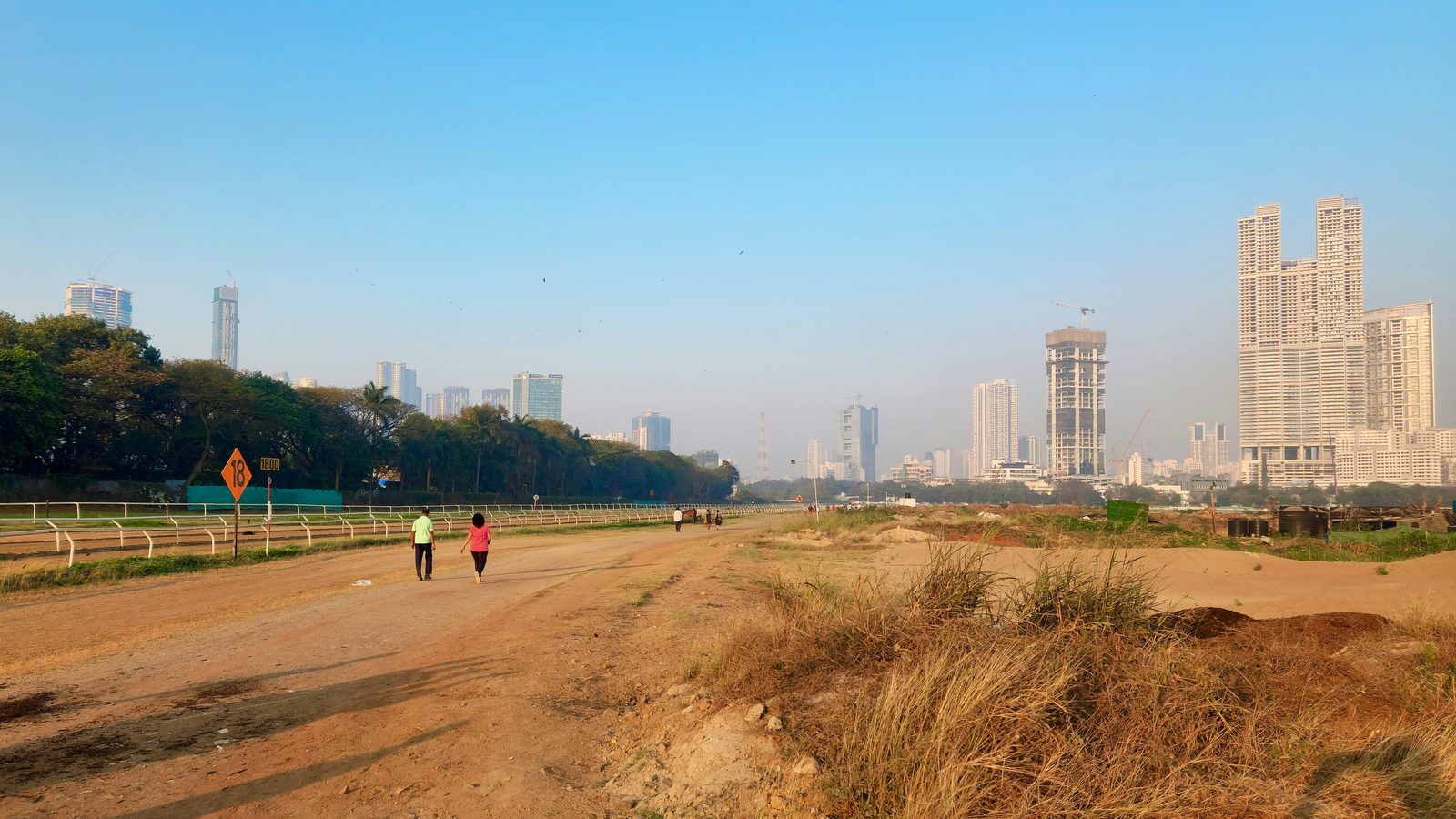
Shivaji Park is usually described as a cricket ground, which is true for about four hours of the day and misleading for the other twenty. The ground is roughly twenty-eight acres of flat open earth in the middle of Dadar West, ringed by a walking track and a low wall, and on any ordinary Tuesday it is doing five or six different jobs at once. Watching it change hands through a day is the clearest way to understand why flats near Shivaji Park Mumbai buyers shortlist cost what they do.
This is not an argument that the view is worth the premium. It is an argument about the ground itself, which belongs to everybody living near Shivaji Park whether or not their window faces it.
Six in the morning, and the ground belongs to the walkers
The track around the perimeter starts filling before it is properly light. The Shivaji Park morning walk is a fixed institution in Dadar West, and the crowd on it is older than the crowd almost anywhere else in central Mumbai at that hour, moving at four or five different speeds in concentric lanes that nobody has ever marked out but everybody observes.
What is striking is how much of it is social rather than athletic. A Shivaji Park morning walk is not really exercise for most of the people doing it. Groups of three and four walk together at a pace that would not trouble anyone, stop at the same corner, and stand there talking for as long as they walked. A laughter club assembles near one gate. The physiotherapy of it matters less than the fact that several hundred people in their sixties and seventies have somewhere to be at six in the morning, within walking distance of home. Nothing is booked and nothing is paid for, which is not something you can say about many open spaces in central Mumbai at that hour.
Half past seven, and the coaching camps take the middle
Cricket at Shivaji Park is the ground's famous function and its most visible one. By half past seven the middle is divided into overlapping practice pitches, each belonging to a different coaching camp, with nets going up along the eastern edge and boys of nine and boys of seventeen working within thirty metres of each other.
Cricket at Shivaji Park has a reputation that is genuinely earned rather than marketed. It has produced Test players over several decades, and the coaching culture around it, run out of the gymkhanas on the perimeter, is a working system rather than a memory. On a Sunday morning in season there can be a dozen matches on simultaneously, with fielders from adjacent games standing back to back and an informal etiquette about whose ball is whose that no visitor ever quite decodes.
The cost of this is dust. From March the surface dries out and the wind lifts it, and anyone living on the lower floors of a building directly on the perimeter will tell you about the film on the window ledges. It is the most common complaint made by people living near Shivaji Park, and it is a real one.
Eleven, and the perimeter becomes an office
The ground empties in the middle of the day and the wall around it fills up. From about eleven the perimeter carries a steady population of people working: a man taking a call while walking a slow loop, two colleagues who have clearly left an office on Gokhale Road to have a conversation they did not want to have at their desks, a college student with a laptop on a bench and a phone propped against a bag.
None of this is what the ground was designed for and all of it is what open ground in a dense city ends up doing. Most 2 BHK flats in Dadar do not have a room you can shut a door on, and most offices on the roads behind the ground do not have a corner where a difficult conversation goes unheard. Anyone living near Shivaji Park has taken a call standing on that wall at least once. The maidan is the overflow space for both. It works because it is large enough to be anonymous and public enough that nobody has to justify being there, and it is the part of the Dadar West lifestyle that no brochure has ever found a way to list.
Every other amenity in central Mumbai can be added to a building later. Twenty-eight acres of open ground cannot be added to a neighbourhood at all.
The katta, and why the benches are the point
Along the northern and western edges the benches and the low wall function as a katta, the Marathi word for the spot where a group habitually sits and talks. The people on a given stretch of wall at five in the evening have often been sitting on that stretch for years, and the composition of each group is stable enough that a regular's absence gets noticed and asked about.
Urban planners write about third places, meaning somewhere that is neither home nor work where people gather without an agenda. Open spaces in central Mumbai are where most of those third places end up attaching themselves, and in Dadar nearly all of them are attached to this ground. It is worth saying plainly that this is not a designed feature and cannot be reproduced by a developer. A society can build a landscaped podium with seating and it will not become a katta, because a katta is made of twenty years of the same people choosing the same wall. It is the least marketable part of the Dadar West lifestyle and probably the most valuable.
Four in the afternoon, and the ground changes hands again
School lets out and the composition shifts within about twenty minutes. Football has been taking territory from cricket at Shivaji Park for a decade now, mostly on the corners, and there is a long-running low-grade argument about the space between the two. Dogs arrive with their owners on the track. Children who are not playing anything organised run around in the space between the games.
The interesting thing about this hour is that nobody is scheduling any of it. The gymkhanas book their pitches. Everything else is negotiated on the spot, between groups who have never met, and it very rarely goes wrong. That is a form of civic competence, and it belongs to the people using the ground rather than to anyone managing it. Open spaces in central Mumbai that get used this loosely are rarer than the acreage suggests.
Evening, and the circuit fills
By seven the walking track is at its fullest of the day and the streets feeding into it are busy in both directions. The evening crowd is younger than the morning one and considerably larger, and the ring of food around the perimeter and along the roads leading off it does most of its business in the next three hours.
Among the things to do in Dadar Mumbai offers on an ordinary weekday evening, the honest answer for most people living near Shivaji Park is a loop of this ground and something to eat afterwards, which is a less exciting answer than a list of destinations and a more accurate one. That is the Dadar West lifestyle at its most ordinary, and it is the version worth testing before you buy into it. The Matunga walk one neighbourhood over is the morning version of the same habit.
What twenty-eight acres does to the streets around it
A ground this size changes the roads that touch it. The buildings on the perimeter are mostly four to seven storeys and mostly from the 1960s and 1970s, which means the skyline stays low and the light stays good, and the residential projects in Dadar that come up nearby are working within a street pattern that was settled long before them. Very few residential projects in Dadar get to start from open land, and the ones on these roads are almost always replacing something.
There is a price to it as well. Parking on the perimeter roads is genuinely difficult, the ground hosts political rallies and Dussehra gatherings that close the roads around it for a day at a time, and the noise question has been through the courts repeatedly, with the ground's status as a silence zone argued over for years. Anyone considering 2 BHK flats in Dadar on those roads should sit on one of those benches on a rally weekend before deciding.
The premium on flats near Shivaji Park Mumbai buyers pay is partly for the view and mostly for proximity, and those are different things worth different amounts. A flat two lanes back, without the view and without the dust, has the same six-minute walk to the same gate. We looked at how that premium works across the pocket in the guide to living near Shivaji Park.
The one amenity that cannot be added later
Open spaces in central Mumbai are, in practice, a fixed stock. No new maidan of this size is going to be created in Dadar, Matunga, Mahim or Worli, because the land does not exist and would not be used this way if it did. Every other amenity a buyer compares between two buildings, the gym and the pool and the landscaped deck, can be built into a project whenever somebody decides to spend the money.
That asymmetry is the whole case for the address, and it is also the reason to be sceptical of how the address gets sold. A brochure that lists the maidan as an amenity is claiming credit for something a municipal corporation laid out a century ago and several generations of people in Dadar West made into what it is. Anyone comparing flats near Shivaji Park Mumbai agents are marketing this season should ask what the building itself offers once the ground is taken out of the pitch. The households who bought here thirty years ago were buying the ground as much as the building, and they paid a fraction of what the same proximity costs now.
Gala Habitats has a project at Aakasa Shivaji Park, so we have an obvious interest in how this ground is valued and you should read the paragraph above about brochures as applying to us too. Our other residential projects in Dadar and the pockets around it are sold on what we build, and we have tried to keep this piece about the maidan rather than about the flats. If you are looking near Shivaji Park Mumbai, walk the perimeter on a weekday morning and again on a rally weekend before you shortlist anything, ours included.
The next Lifestyle piece follows the same method south, to the Worli sea face after dark.