
Strictly, none of it is. A title deed records who owns the land and the flat, and how ownership passed from one hand to the next. The construction specification of a Gala Habitats home sits in two other documents: the schedule of specifications attached to the agreement for sale, and the project's MahaRERA filing.
This piece translates that specification. A buyer cannot read a structural drawing and should not have to. What a buyer can understand is which wall is likely to seep in the third monsoon, and which building will need its columns repaired at forty. So each line below is written as a decision we made, what it costs, and what it should mean for the flat at year 5 and at year 15. It is the structural specification residential building buyers in Mumbai are rarely shown in plain language, followed by a short list of how to check construction quality of a flat, and Gala Habitats would rather be judged on both than on a brochure.
Why an M40 grade concrete residential building costs more to build
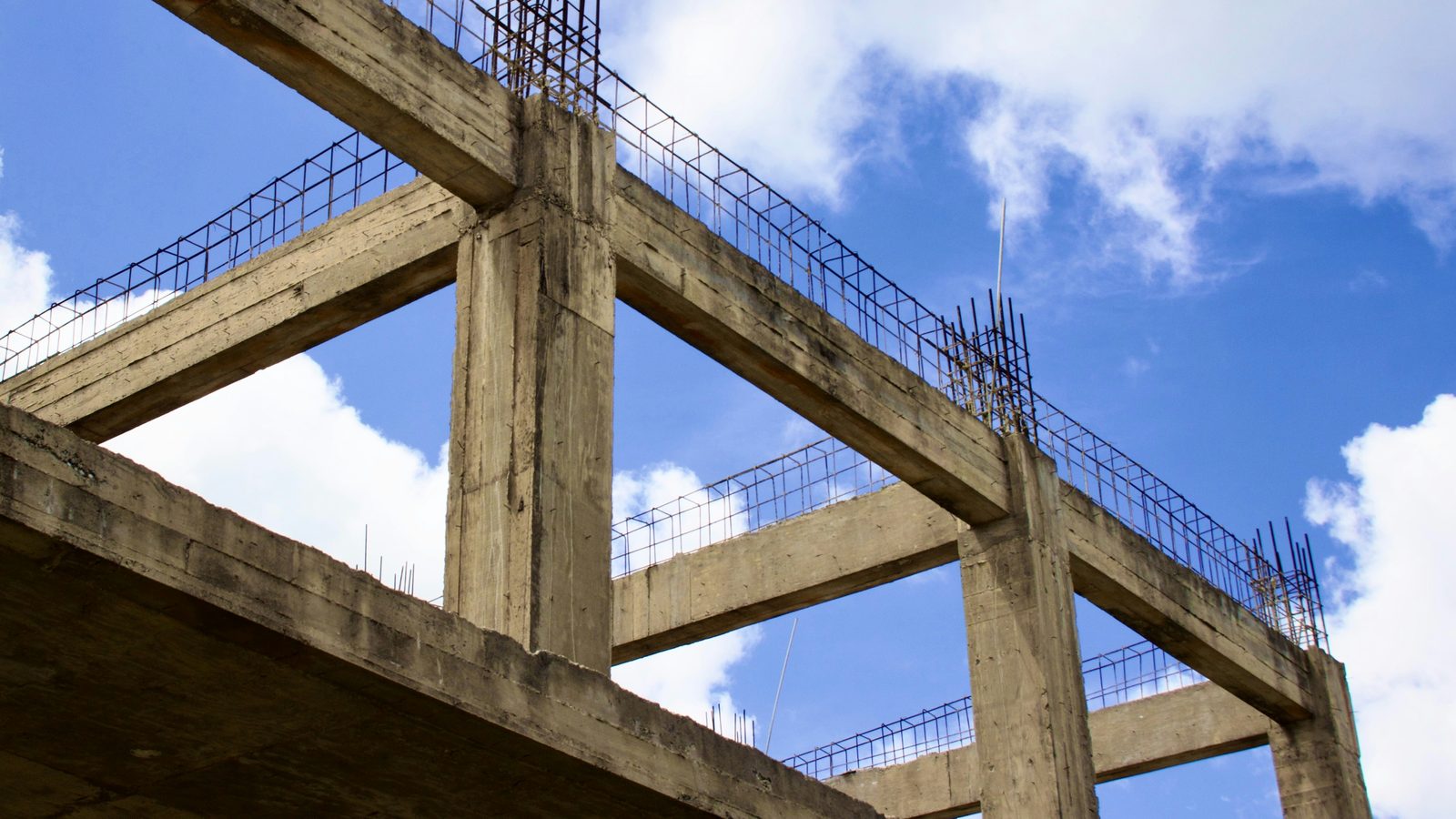
The number in a concrete grade is its strength. In an M40 grade concrete residential building, the columns are designed to reach a characteristic compressive strength of 40 newtons per square millimetre after 28 days. IS 456, the code that governs reinforced concrete in India, sets a minimum grade for each exposure condition, and a building in coastal Mumbai exposed to sea air counts as severe exposure, for which the minimum is M30.
Gala Habitats specifies M40 for columns and shear walls, and M30 for slabs. Slabs sit inside the building, away from the weather, so we do not pay for the higher grade there.
The cost is real. Higher grade concrete needs more cement and less water, which in turn needs chemical admixtures to stay workable, and it needs closer supervision on site, because a batch watered down to pour more easily loses exactly the property we are paying for.
The reason is corrosion. The damage visible on older Mumbai buildings at thirty years, from cracked plaster along a column to rust stains and eventually exposed steel, is almost always reinforcement rusting inside concrete that let moisture and salt through. Denser concrete slows that down, which is the whole case for an M40 grade concrete residential building on a coastal island. At year 5 there is no visible difference between an M30 and an M40 column. At year 15 the difference should still be invisible, which is the point: the failure we are designing against belongs to year 30 and beyond, when a society is deciding whether to repair or redevelop.
Grade is also the easiest number to print and the least useful on its own. The depth of concrete covering the steel matters at least as much, and so does how well the concrete was compacted and cured. A well cured M30 column will outlast a badly cured M40 one, and an M40 grade concrete residential building is only as good as the site team that poured it.
Seismic zone 3 Mumbai construction, and what ductile steel is for
Mumbai sits in seismic Zone III under IS 1893, the Indian earthquake code, which treats it as a moderate risk area with a zone factor of 0.16. The rules for seismic zone 3 Mumbai construction require a frame designed for that loading and detailed for ductility under IS 13920, so that beams and columns bend and crack visibly before they fail.
That is compliance, not a feature. Every properly approved building in the city has to meet the same seismic zone 3 Mumbai construction rules. We list them because a buyer should confirm them, not because they set us apart.
The decision inside the compliance is the steel. Gala Habitats uses Fe 500D TMT bars. The 500 is the yield strength in newtons per square millimetre, and the D marks a grade with higher elongation, meaning the bar stretches further before it breaks. In an earthquake that stretch is what turns a sudden collapse into a slow, visible failure that people have time to leave. The real cost is in the detailing, where closely spaced ties at beam and column joints make those joints congested and slower to cast well.
At year 5 and year 15 none of this seismic zone 3 Mumbai construction work is visible, and in most buildings it never will be. It matters on the one day it is needed, and on the day a bank's valuer or a structural consultant asks for the design basis.
What a waterproofing warranty in new flats covers
The Gala Habitats specification calls for an SBR-modified membrane on terraces, basements and wet areas, backed by a ten-year warranty from the manufacturer.
A waterproofing warranty in new flats usually covers the product. It does not cover the joint around a pipe that was cut through the membrane after it went down, or the gap between an aluminium window frame and the wall around it. In Mumbai those junctions, and not the membrane itself, are where most seepage starts.
So the useful questions about any waterproofing warranty in new flats are practical ones. Who applied the membrane, and is that applicator named on the certificate? Was each bathroom and the terrace flood tested before the tiles went down, and is there a record of it? Is the certificate made out to the society, so that it survives the developer's handover?
A ten-year warranty covers the waterproofing membrane, and almost every Mumbai leak starts at the joint beside it.
At year 3, after the first real monsoons, seepage at window junctions shows up if it is going to, and that is well inside the RERA defect liability period. At year 12 even a ten-year waterproofing warranty in new flats has run out, and the terrace membrane is the society's to inspect and recoat. A society that budgets for it avoids the top-floor ceiling stains most Mumbai buildings eventually get.
Pipes, wires and the lift in a power cut
Two decisions about services sit outside the structural specification residential building buyers usually ask about, and their consequences arrive slowly.
The first is pipework. Older Mumbai buildings plumbed in galvanised iron rust from the inside, and after fifteen or twenty years the leaks begin inside walls, where they are expensive to find. The Gala Habitats specification uses CPVC pipework, which does not corrode. It costs more than the cheapest option and needs careful jointing, and at year 15 it should mean the walls are dry.
The second is the lift. Gala Habitats lifts are specified with an automatic rescue device, which moves a stalled car to the nearest floor and opens the doors when the power fails. A power cut with an elderly parent stuck between floors is a small risk on paper. It is also the kind a family remembers for years.
Wiring is ISI-marked copper with circuit protection on the distribution board. That is a baseline, listed only so a buyer knows to check for it.
The RERA defect liability period, in practice
Section 14(3) of the Real Estate (Regulation and Development) Act sets the RERA defect liability period. It makes a developer responsible for structural defects, and for defects in workmanship, quality or services, reported within five years of handing over possession. The developer has to fix them within 30 days at no charge, and a buyer left waiting is entitled to compensation.
Brochures do not always match it. The five years covers workmanship as well as structure. A promise of five years on structure and one year on finishes describes less than the law already gives the buyer, and the law is what applies. That is the RERA defect liability period on every Gala Habitats home, because it is the period on every registered project.
In practice the RERA defect liability period is only as useful as the record behind it. Report a defect in writing, with dated photographs, and keep the acknowledgement. The clock runs from the date possession is handed over, so a flat that sits locked and empty for its first two years still loses those two years of cover.
How to check construction quality of a flat, ours included
None of the above should be taken on trust, including from us. Here is how to check construction quality of a flat without hiring an engineer.
- Ask for the 28 day cube test results for the concrete in your tower's columns, and the name of the laboratory that tested them.
- Ask for the certificate behind any waterproofing warranty in new flats and the name of the applicator, and confirm who the certificate is made out to.
- Read the architect's and engineer's certificates filed with each MahaRERA progress update.
- Visit during the monsoon if you can, and look at the underside of balconies and the inside face of external walls around the windows.
- At possession, tap every floor and wall tile with a coin. A hollow sound means an air gap under the tile, and those tiles crack later.
- Run every tap and flush for several minutes, then check the floor trap and, if the flat below is accessible, its ceiling.
The piece on RERA, OC and CC covers the approvals side of the same checklist.
What the Gala Habitats specification does not promise
A structural specification residential building buyers can read is still only a floor. It says what goes into the building, not how well it was put there, and the difference between the two is supervision, which no schedule can capture. That is why the site teams matter more to us than the grades, why knowing how to check construction quality of a flat matters more than any grade printed in a brochure, and why the piece on why we build inside one corridor argued for the same people doing the same work on every site.
It does not equalise location either. The same specification applies whether the building is one of our residential projects in Dadar, one of the new projects in Worli that face the sea, or a tower of 3 BHK flats in Matunga. A sea-facing façade on one of the new projects in Worli will still need more maintenance than an inland tower of 3 BHK flats in Matunga, because salt air works on paint, railings and window seals regardless of what is inside the concrete.
This is the one Insights piece where Gala Habitats is the subject rather than a disclosure, so read it as a developer describing its own work. The specification here is the one Gala Habitats holds across its residential projects in Dadar, Matunga and Worli: Paramount Matunga, Aakasa Shivaji Park and Aakasa Worli. Material lists, consultant credentials and third-party inspection reports are available on request, and a buyer who asks for them should receive them.
The next Developer POV piece is written for society committees: ten clauses to read before a redevelopment agreement is signed.